LX Gas Spring Resource
Gas Spring Specifications Explained: F1, F2, Progression, Stroke and Lengths
What F1, F2, progression (k factor), friction, stroke, extended and compressed length, rod and tube size mean on a gas spring datasheet, with examples.

A gas spring datasheet packs a lot into a few numbers. Reading them correctly is the difference between a lid that opens smoothly and one that slams up or will not stay open. This guide defines each specification and shows how they fit together.
Short answer: F1 is the extension force near the fully extended position, F2 is the force near the fully compressed position, progression (the k factor, F2 ÷ F1) tells you how much the force rises as the spring is pushed in, stroke is how far the rod travels, and extended length = compressed length + stroke.
The Force Values
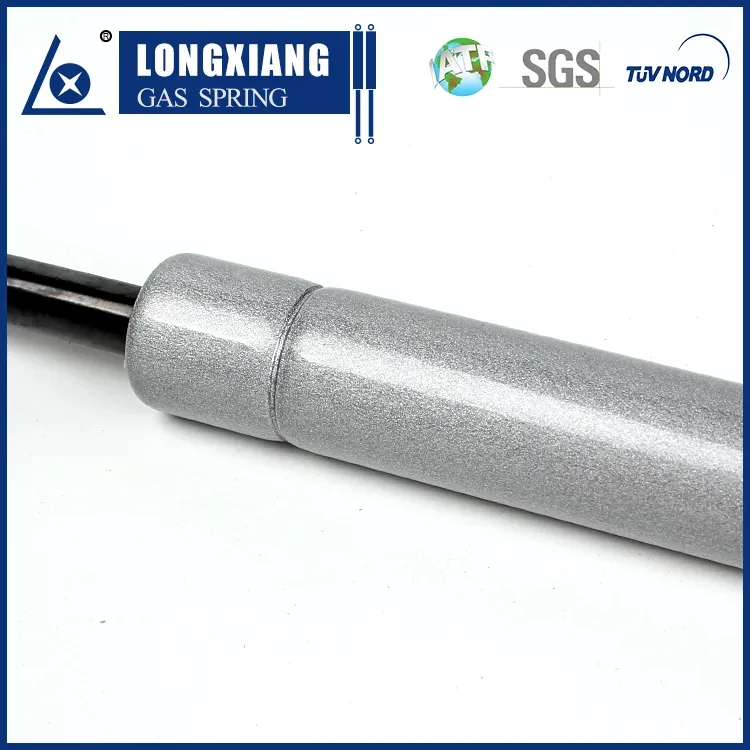
- F1 (nominal force): the extension force measured close to the fully extended position, commonly about 5 mm from the end of travel. This is the number usually quoted as "the force", for example 200 N.
- F2: the extension force measured close to the fully compressed position. Because the gas is compressed into a smaller volume, F2 is always higher than F1.
- Progression or k factor: k = F2 ÷ F1. A spring with F1 = 200 N and F2 = 260 N has a progression of 1.3. A lower k gives a flatter, more even force; a higher k gives a stronger push when closed and a lighter feel when open.
- Friction force: the difference between the force measured while compressing and while extending at the same point. Friction comes mainly from the seal and makes the spring feel lighter when you push it in.
Length and Stroke
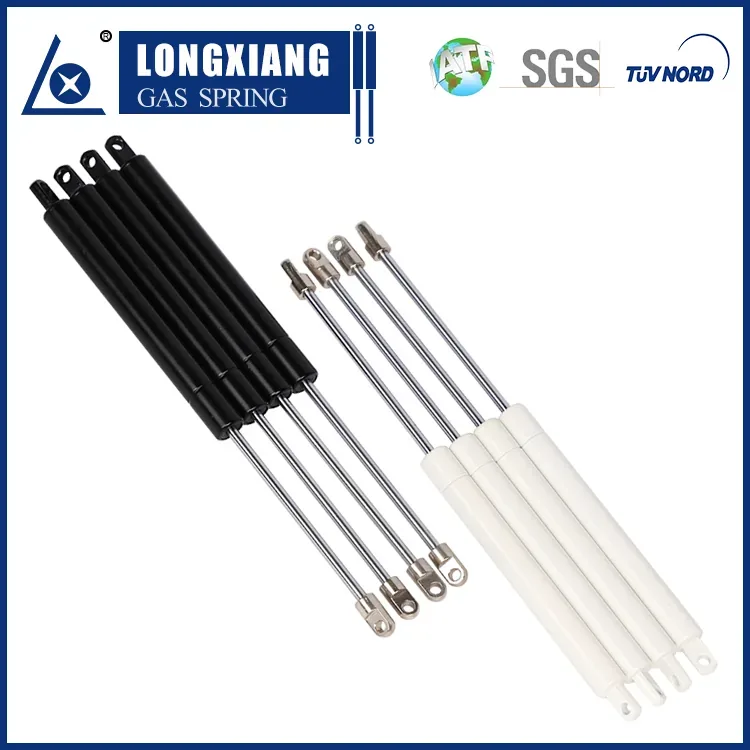
- Stroke: the distance the rod moves from fully extended to fully compressed.
- Extended length: the centre-to-centre length of the end fittings with the rod fully out.
- Compressed length: the centre-to-centre length with the rod fully in. Extended length = compressed length + stroke.
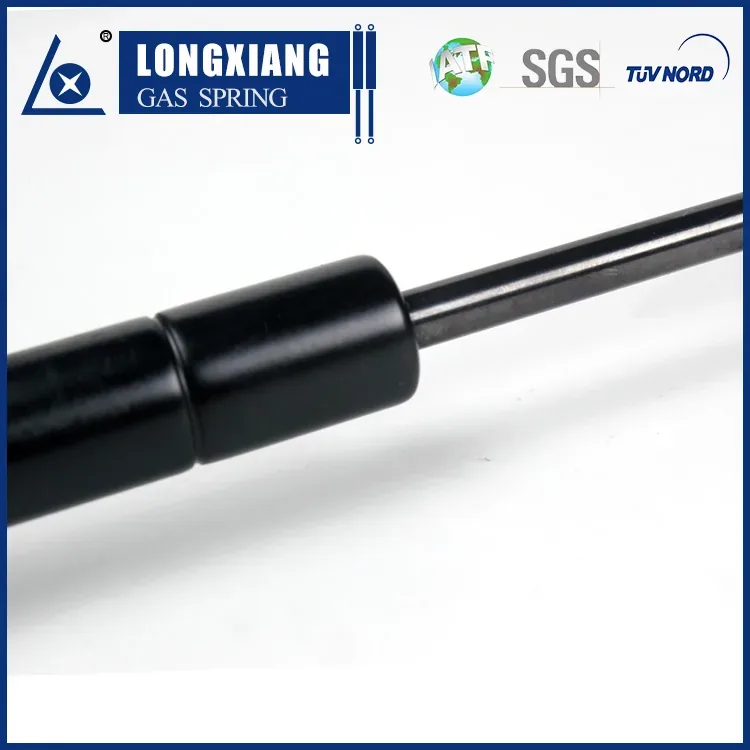
- Rod and tube diameter: written as rod/tube, for example 10/22 mm. Thicker rods carry higher forces and resist buckling on long strokes.
How to Read a Gas Spring Specification
| Specification | Example value | What it tells you |
|---|---|---|
| F1 | 200 N | Force near full extension; the nominal force |
| F2 | 260 N | Force near full compression |
| Progression (k) | 1.3 | How much the force rises through the stroke |
| Stroke | 150 mm | Rod travel |
| Extended length | 400 mm | Centre-to-centre, rod fully out |
| Compressed length | 250 mm | Extended length minus stroke |
| Rod / tube | 10/22 mm | Size class, force range, buckling resistance |
| End fittings | 10 mm ball socket both ends | How the spring connects to the brackets |
| Damping | Oil damping at end of extension | How the lid slows before fully open |
LX Gas Spring Size Classes
| Rod / tube | Typical use |
|---|---|
| 6/15 mm | Light lids and small covers, about 10-50 N |
| 8/18 mm | Medium covers and cabinet doors, about 100-500 N |
| 10/22 mm | Heavier hatches, covers and machine guards |
| 14/28 mm | Heavy-duty panels, about 1,000-2,500 N |
Across the range, LX gas springs cover about 10 N to 2,500 N with strokes from 20 mm to 1,000 mm and an operating temperature of -30 °C to +80 °C.
End Fittings and Thread Size
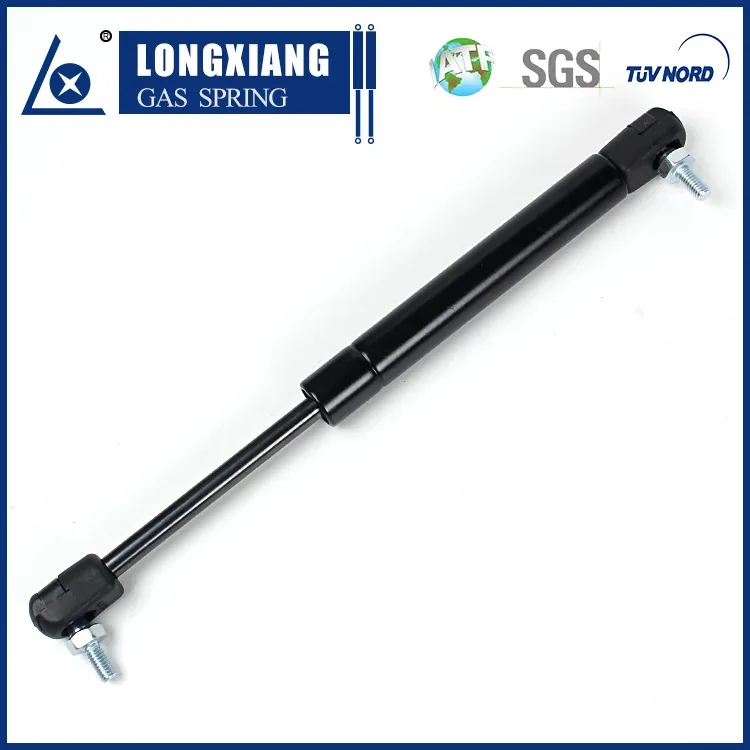
The end fitting changes the centre-to-centre length, so always state lengths with the fittings you will use. Common options are plastic or metal ball sockets, eyelets, clevis forks, blade ends, and threaded studs. See the end fittings guide.
Common Specification Mistakes
- Quoting only the force and stroke, without extended length and fittings.
- Measuring an old spring from end to end instead of centre to centre of the fittings.
- Assuming F1 is constant through the stroke and ignoring progression.
- Choosing force at room temperature for equipment used in the cold; gas spring force drops as the temperature falls.
- Ordering a longer stroke than the mechanism allows, so the rod bottoms out.
Use the force calculator to estimate F1, the dimensions guide to measure lengths, and compare lift gas springs for standard sizes.
Frequently Asked Questions
What does F1 mean on a gas spring?
F1 is the extension force measured near the fully extended position. It is the nominal force quoted for the spring, for example 200 N.
What is the difference between F1 and F2?
F2 is measured near the fully compressed position and is higher than F1 because the gas is compressed into a smaller volume.
What is a gas spring k factor?
The k factor, or progression, is F2 divided by F1. It shows how much the force increases as the spring is compressed.
How do I calculate the compressed length of a gas spring?
Compressed length = extended length minus stroke, both measured centre to centre of the end fittings.
What does 10/22 mean on a gas spring?
It is the rod and tube diameter in millimetres: a 10 mm piston rod in a 22 mm pressure tube.