LX Gas Spring Resource
Gas Spring End Fittings: Ball Sockets, Eyelets, Clevises, Blade Ends and Brackets
Choose gas spring end fittings by articulation angle, bracket space, load path, alignment tolerance, material, corrosion exposure, and installation access.
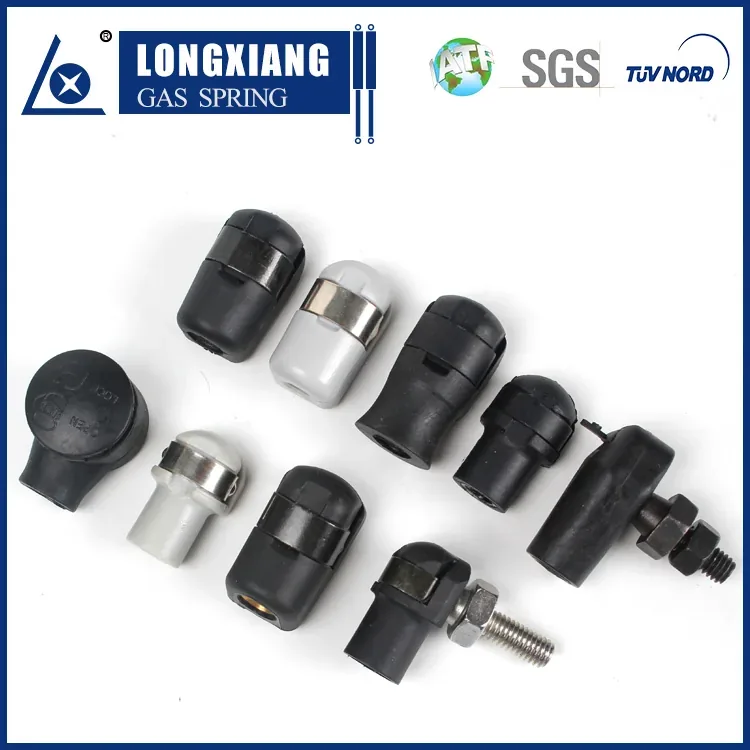
End Fittings Decide How the Gas Spring Moves
The end fitting connects the gas spring to the bracket and controls how freely the part can articulate. A force and length match can still fail if the fitting binds, collides with the frame, or transfers side load into the rod. Choose fittings by the movement path, bracket space, load, material, and service access.
Short answer: use ball joints or ball sockets when the mounting angle changes through the stroke, eyelets, clevis forks, or blade ends for fixed pivots and higher loads, threaded studs where the fitting is screwed into a bracket, and stainless steel fittings for marine, washdown, or outdoor use.
End Fitting Types at a Glance
| Fitting | Best for | Watch out for |
|---|---|---|
| Metal ball socket | Lids, hatches, tailgates; angle changes through the stroke | Ball stud size must match; needs a retaining clip on vibrating equipment |
| Plastic ball socket | Light furniture and cabinet doors | Load and temperature limits; not for heavy or safety-related panels |
| Eyelet | Fixed pivots, compact space, higher loads | Little tolerance for misalignment |
| Clevis fork | Fixed pivots with a pin; machinery and guards | Pin diameter and clevis gap must match the bracket |
| Blade (flat) end | Narrow brackets, stamped or welded parts | Needs side clearance to avoid binding |
| Threaded stud | Screwing into a bracket or adding another fitting | Thread size and engagement length |
| Spherical rod end | Larger angular movement under load | Size and load rating of the bearing |
| Angle or flat bracket | Moving the mounting point without changing the panel | Bracket stiffness and fastener strength |
Ball Joints and Ball Sockets
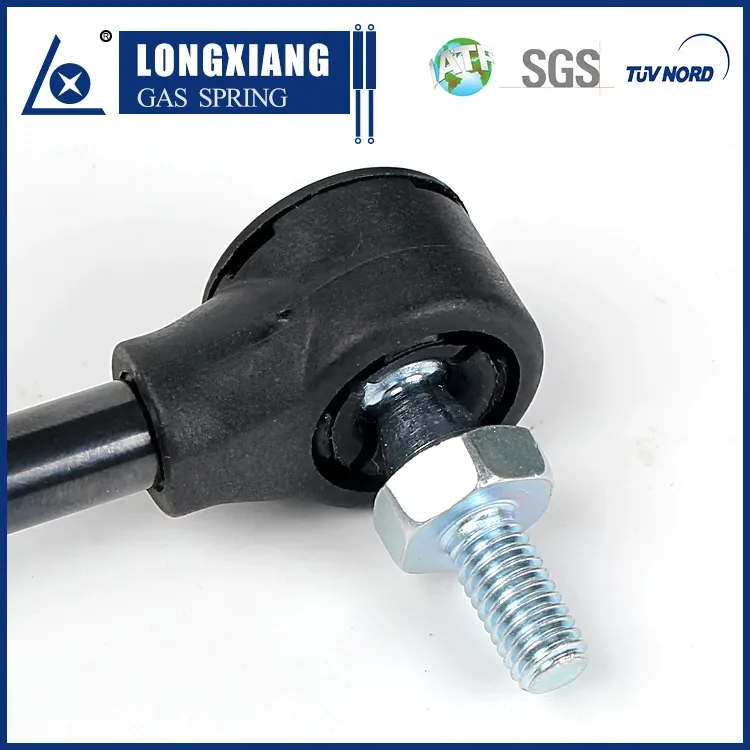
Ball joints are the most common fitting because they allow the spring to swing as the lid or panel moves. They suit vehicle hoods and tailgates, toolboxes, cabinets, and access panels. Metal ball sockets carry higher loads; plastic ball sockets are light and quiet for furniture. On equipment that vibrates, use a ball socket with a retaining clip so it cannot pop off the stud.
Ball Socket and Ball Stud Sizes
A ball socket only fits a ball stud of the same ball diameter. Measure the ball across its widest point with a caliper; 10 mm and 13 mm ball sockets are common on vehicle applications, and smaller sizes are used on furniture. The ball stud is screwed or welded to the bracket, so also note the stud thread and the length of the neck between ball and bracket. A ball joint gas spring suits lids and hatches whose mounting angle changes as they open; see the ball joint gas spring and the standard ball joint gas spring.
Eyelets, Clevis Forks, and Blade Ends
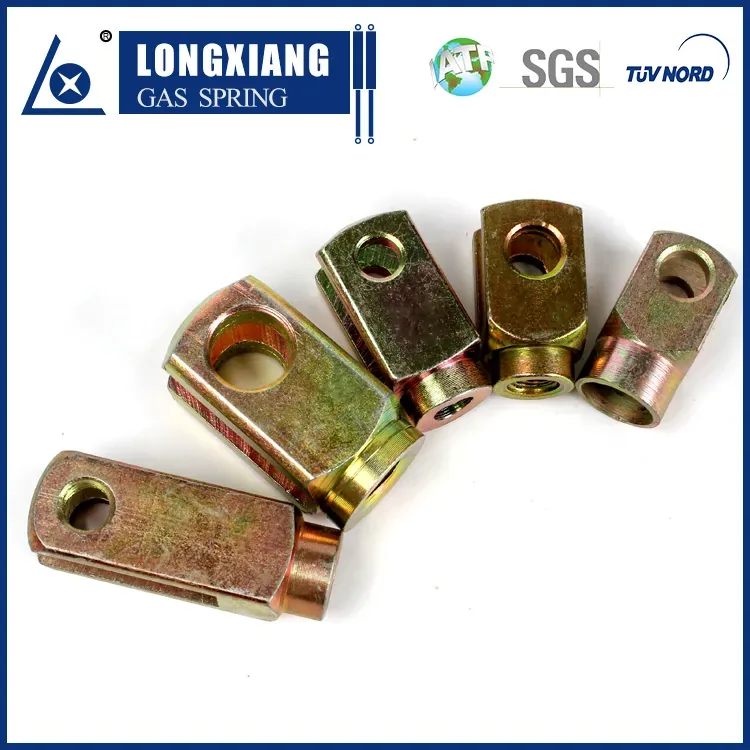
Eyelets, clevis forks, and blade ends connect to a fixed pivot pin. They are compact and strong, which makes them a good choice for machinery covers, guards, and heavy hatches. Because they do not swivel like a ball joint, the brackets must keep the spring in one plane; otherwise the fitting forces side load into the rod and seal.
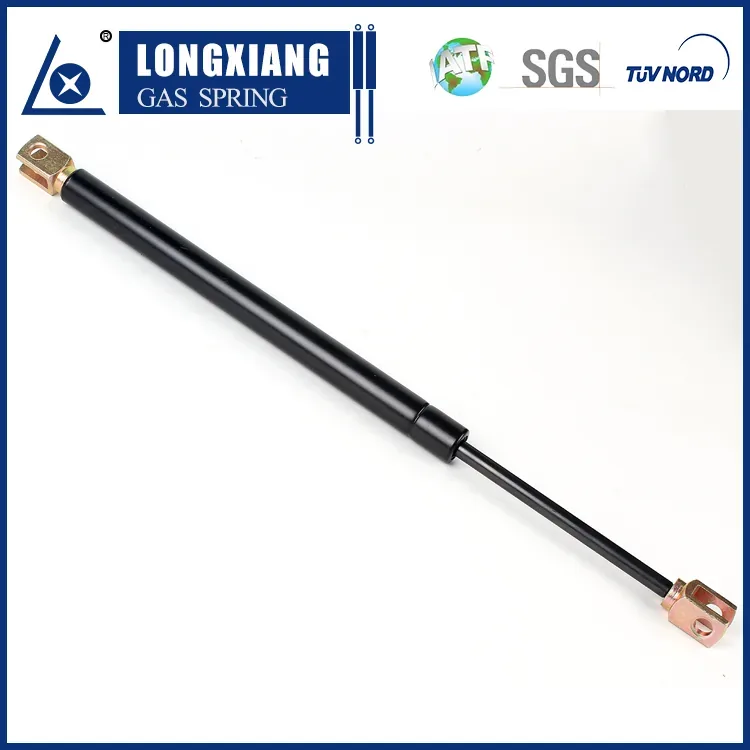
An eyelet is a ring on the end of the spring that takes a pin or bolt through it; it is compact and carries high loads. A clevis fork wraps around a flat bracket or lug and takes a pin across both sides, which keeps the spring centred on the bracket; see the clevis end support gas spring. A blade or flat end is a flat tab with a hole, used on narrow stamped or welded brackets; see the heavy-duty combination flat end gas spring. For all three, record the pin or hole diameter, the width of the fitting and the clearance on each side.
Threaded Ends
Many gas springs have a threaded rod end and tube end so that the fitting can be changed, or they are supplied with an internal thread for your own fitting; see the internal thread gas spring. To identify a thread, measure the outside diameter of the stud (or the inside diameter of the hole) with a caliper and the pitch with a thread gauge; gas spring threads are usually metric. Note how deep the thread engages, because a short engagement can strip under a heavy load.
Spherical Rod Ends
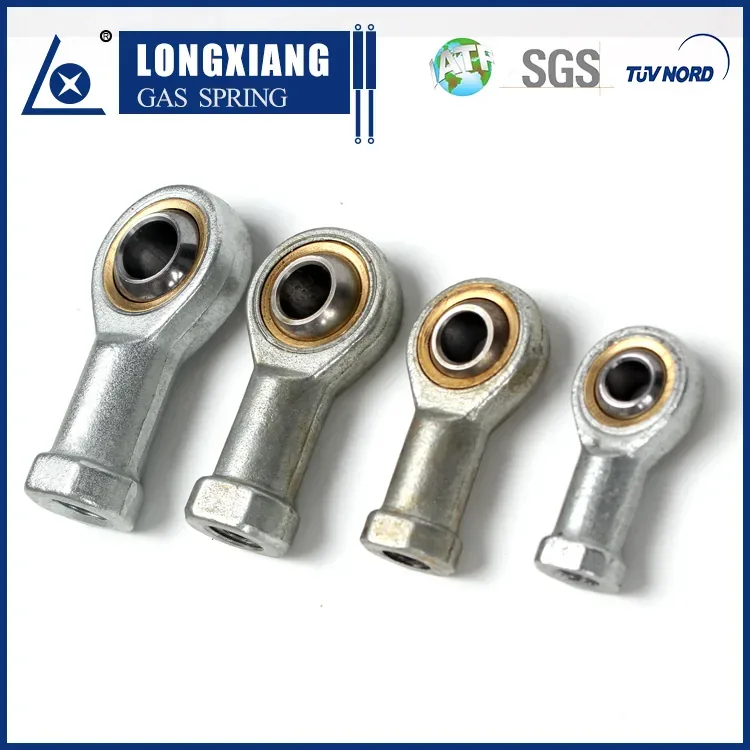
Spherical rod-end bearings combine a pin connection with angular freedom. They are useful when a fixed pin is needed but the mounting points are not perfectly aligned or move slightly under load.
Load and Articulation by Fitting
| Fitting | Angular movement | Load |
|---|---|---|
| Plastic ball socket | Swivels in all directions | Light: cabinets and furniture |
| Metal ball socket | Swivels in all directions | Medium to high: lids, hoods, hatches |
| Eyelet | Rotates around the pin only | High: machinery, heavy covers |
| Clevis fork | Rotates around the pin only | High; keeps the spring centred on the bracket |
| Blade end | Rotates around the pin only | Medium to high on narrow brackets |
| Spherical rod end | Pin connection with some angular freedom | High, where alignment is not perfect |
Angle (L) Brackets
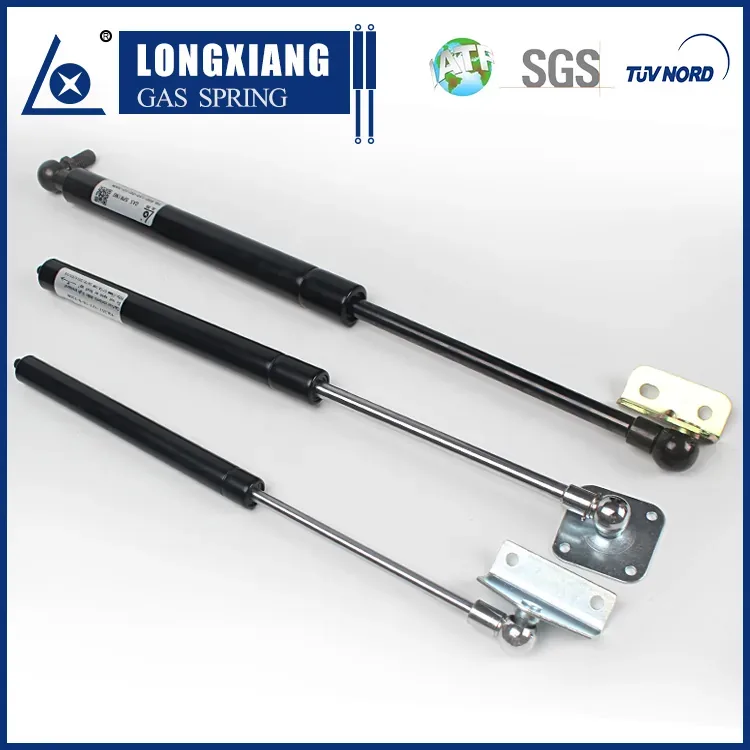
Angle and flat brackets let you put the mounting point where the force calculation needs it, without redesigning the panel. A strong gas spring fitted to a weak bracket or thin sheet can tear out the mounting point, so check bracket thickness, reinforcement, and screw engagement. An L-shaped angle bracket moves the pivot away from the panel surface so the spring can pass the hinge or clear a frame; a flat bracket spreads the load over a larger area of thin sheet. Brackets, ball studs and release hardware are listed under gas spring accessories.
Material and Environment
Standard steel fittings work for most indoor and protected uses. SS304 or SS316 stainless steel fittings should be used for marine, washdown, food, outdoor, humid, or corrosive applications, together with a stainless steel gas spring. Plastic fittings may suit light furniture but must match the load, temperature, and cycle expectation.
How to Choose: A Quick Checklist
- Does the mounting angle change through the stroke? Use ball joints.
- Is it a fixed pivot with a pin, or a high load? Use an eyelet, clevis, or blade end.
- Is space very narrow? Consider a blade end or threaded stud.
- Is the environment wet, salty, or washed down? Use stainless steel fittings.
- Does the equipment vibrate? Use retaining clips or a pinned connection.
RFQ Checklist
Send photos of both ends, centre-to-centre length, thread size if known, ball stud size, bracket thickness, required rotation, environment, force, stroke, and quantity. If you are replacing a part, photograph the old fitting from the side and front so the connection type is clear.
Use this guide with the mounting guide, the specifications guide, and the dimensions guide, then compare gas spring accessories.
Frequently Asked Questions
How do I measure the ball size of a ball socket?
Measure the ball stud across its widest point with a caliper. The socket must match that diameter; 10 mm and 13 mm are common on vehicles.
Should I use an eyelet or a clevis fork?
Use an eyelet when the bracket has a pin or bolt that passes through the spring end. Use a clevis fork when the bracket is a flat lug: the fork wraps around it and keeps the spring centred.
How do I find the thread size of a gas spring end?
Measure the outside diameter of the threaded stud with a caliper and the pitch with a thread gauge. Gas spring threads are usually metric.
Can I reuse old brackets with a new gas spring?
Sometimes, but check ball size, thread, bracket strength, pivot clearance, and whether the old bracket caused the failure.
Are plastic end fittings suitable for heavy lids?
Only when the fitting is rated for the load and application. Heavy or safety-related panels usually need metal fittings.
Which end fitting allows the most movement?
Ball joints and spherical rod ends allow angular movement; eyelets, clevis forks, and blade ends need the spring to stay in one plane.
Do end fittings change the length of a gas spring?
Yes. Lengths are measured centre to centre of the fittings, so changing the fitting changes the installed length.
Why do end fittings wear quickly?
Common causes are side load, poor alignment, vibration, undersized fittings, corrosion, or loose fasteners.