Lift Gas Spring
Standard Ball Joint Gas Spring
Standard ball joint gas spring for OEM lift support, cabinet doors, vehicle panels, machinery covers, toolboxes, and custom gas strut replacement projects.
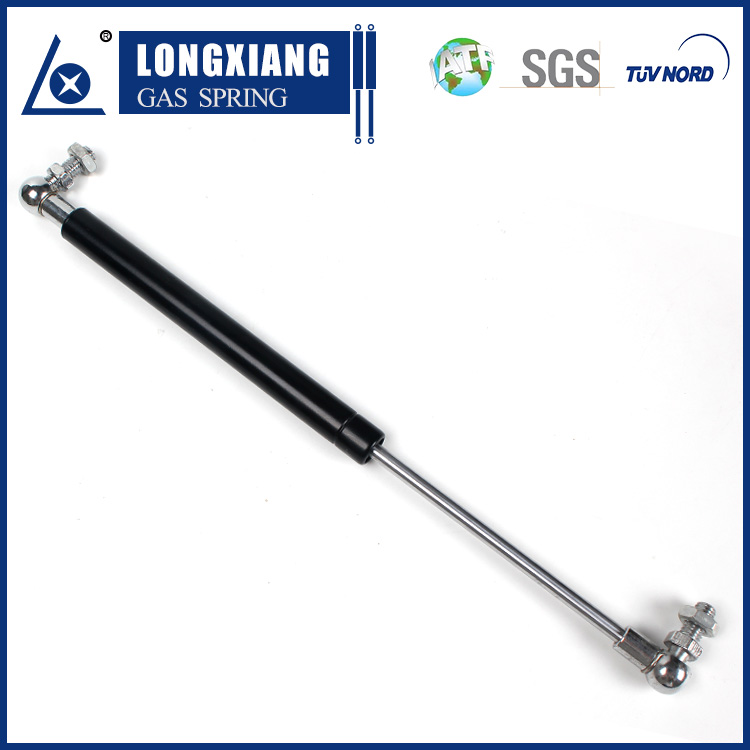
Product Overview
Standard Ball Joint Gas Spring is a practical lift-support choice when the assembly needs smooth opening, stable hold-open assistance, and enough articulation at both mounting points. The ball socket connection lets the gas spring follow a changing hinge angle, which makes it useful for cabinet doors, access panels, truck toolboxes, vehicle hoods, equipment covers, and many replacement gas strut projects. For OEM use, LX Gas Spring reviews the real bracket position, lid weight, open angle, stroke, extended length, compressed length, and force before confirming samples.
Ball joint gas springs should not be selected by force alone. Confirm the ball stud diameter, socket clearance, mounting-center distance in the open and closed positions, rod-down orientation, and whether a pair of struts is needed to prevent twisting.
Key Features
- Ball socket end fittings allow angular movement during the lid or panel travel.
- Suitable for OEM lift support where brackets are already designed around ball studs.
- Custom force, stroke, tube color, rod finish, and end fitting options can be reviewed.
- Useful for sample matching when an old gas strut has missing or unclear markings.
Technical Specifications / Product Details
- Product type: lift gas spring with ball joint end fittings
- Connection check: ball stud size, socket type, bracket thickness, and articulation angle
- Selection inputs: moving weight, hinge position, center of gravity, open angle, stroke, and mounting distance
- Common OEM options: force rating, stroke, extended length, compressed length, rod finish, tube color, and label
- Installation risk: side load, misaligned ball studs, insufficient compressed length, or paired struts with unequal geometry
What to Confirm Before Ordering
- Check the gas spring from the installed hinge geometry, not only from the printed force on an old strut.
- Confirm that compressed length leaves clearance before the lid or cover reaches the closed position.
- Review whether one gas spring or a matched pair is needed to avoid twisting wide lids and panels.
- Use real bracket positions when estimating force because a short lever arm can require a much higher Newton rating.
Common Specification Risks
- Too much force can make closing difficult and overload hinges, brackets, or thin sheet-metal panels.
- Side load from misaligned brackets can scratch the rod, wear seals, and shorten service life.
- A gas spring that fits open length may still bottom out if compressed length is ignored.
- Replacing only one gas spring on a paired installation can cause uneven motion.
OEM Manufacturing Support
- Force, stroke, extended length, compressed length, rod finish, tube color, and end fittings can be reviewed for OEM supply.
- Samples should be tested in the final lid, hatch, cabinet, vehicle, or equipment assembly before production approval.
- Approved parts can be documented by drawing, force range, fitting style, labeling, packaging, and batch reference.
Common Applications
Customization Options
- Force adjusted after reviewing lid weight and bracket geometry.
- Ball socket and ball stud specification matched to the customer bracket.
- Tube color, rod finish, and label prepared for OEM assembly or spare-part programs.
- Sample review available when replacing Suspa, Stabilus, or other gas strut references.
How to Request a Quote
Send the following information with your drawing, sample photo, or application sketch for a practical OEM gas spring recommendation.
- Application photos showing hinge and bracket locations
- Panel or lid weight and open angle
- Extended length, compressed length, and stroke
- Ball stud diameter and socket style
- Quantity, environment, tube color, and required packaging
Related Resources
Related Products in This Family
Product FAQ
When should a ball joint gas spring be used?
Use a ball joint gas spring when the mounting points need angular movement as the lid, hatch, or cover opens and closes.
Can LX Gas Spring match an existing ball joint gas strut?
Yes. Send the old part markings, extended length, compressed length, stroke, ball stud size, force marking, and photos of both ends.
Why do some ball joint gas springs fail early?
Common causes include side loading, incorrect rod orientation, weak brackets, mismatched paired struts, insufficient compressed length, or contaminated ball sockets.