Lockable Gas Spring
Cable Release Lockable Gas Spring
Cable Release Lockable Gas Spring for OEM use. Review mounting, dimensions, operating conditions, and custom production with LX Gas Spring.
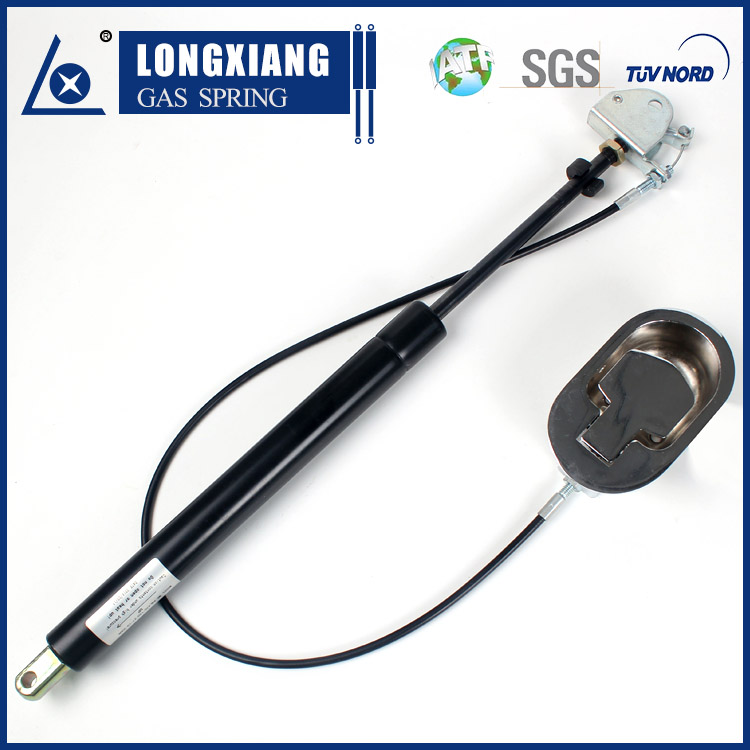
Product Overview
Cable Release Lockable Gas Spring is intended for medical, furniture, and industrial mechanisms where the release control is separated from the gas spring. For an OEM specification, the product should be reviewed as part of the complete mechanism rather than selected from appearance alone. LX Gas Spring can then match force or damping behavior, stroke, installed length, material, and end connections to the drawing or sample. A cable release puts the handle where the user can reach it, such as a bed side rail, under a seat or at a table edge, while the gas spring stays hidden in the mechanism. A lever or paddle handle pulls a Bowden cable that presses the release pin; cable length, routing and handle position are made to the drawing, and a dual cable system can release two springs together. The standard KQL lockable range covers about 200-900 mm extended length, 40-350 mm stroke and 60-1,100 N.
Exact force, stroke, length, and fitting dimensions should be confirmed from your drawing, sample, or installation measurements before production.
Key Features
- Application focus: medical, furniture, and industrial mechanisms where the release control is separated from the gas spring.
- Quality: TÜV fatigue test passed at 180,000 cycles; 3-year warranty on all LX gas springs.
- Supports controlled adjustment and position holding along the stroke.
- Useful for medical, furniture, vehicle accessory, and industrial positioning mechanisms.
Technical Specifications / Product Details
- Product family: Lockable Gas Spring
- Product-specific use: medical, furniture, and industrial mechanisms where the release control is separated from the gas spring
- Testing: force measurement, cycle endurance, and salt spray tests available in the in-house laboratory
- End fitting reference: Lever Release
- Force or damping requirement: confirmed from load, geometry, motion direction, and operating conditions
- Stroke and installed length: checked at both end positions before sample approval
What to Confirm Before Ordering
- Show the cable route, bend points, mounting clips, and release-handle position on the mechanism drawing.
- Check that the cable can fully release and reset the lock at each intended holding position.
- Define cable length, minimum bend radius, end termination, routing clips, adjustment allowance, and service access.
- Define whether the application needs rigid holding, elastic holding, or simple adjustable support before choosing a model.
- Confirm release-control location, cable route, lever access, and operator hand position during real use.
- Test locking behavior at the working angles users actually need, not only at full extension.
- Check whether the gas spring supports equipment weight, user-applied load, or both.
Common Specification Risks
- Tight bends and poor cable adjustment can create lost motion or continuous pressure on the release pin.
- Incorrect release travel can make the lock difficult to open or unable to release fully.
- Cable bends, tight routing, or poor lever access can make a good gas spring feel unreliable in the final product.
- A lockable gas spring should not be treated as a normal lift strut with extra force.
- Weak brackets can reduce locking stability even when the gas spring itself is correctly selected.
OEM Manufacturing Support
- Locking behavior, release head, lever, cable, stroke, force, and end fittings can be matched to the OEM mechanism.
- Medical, furniture, seating, workstation, and industrial adjustment projects should go through sample validation.
- Production approval should record the release system, locking direction, force range, travel, mounting points, and packaging.
Common Applications
Customization Options
- Stroke length and locked position behavior.
- Release head, cable release, lever release, or remote actuation layout.
- End fittings and brackets matched to the mounting geometry.
- Force and damping feel reviewed according to load and operator comfort.
How to Request a Quote
Send the following information with your drawing, sample photo, or application sketch for a practical OEM gas spring recommendation.
- Cable length, routing sketch, bend radii, control location, and release-head type
- Application and installation photos
- Panel, lid, or moving part weight
- Stroke, extended length, and compressed length
- Mounting point distance and opening angle
- Required force or sample part number if available
- End fitting type, quantity, and working environment
Related Resources
Related Products in This Family
Product FAQ
Where is Cable Release Lockable Gas Spring typically used?
It is suitable for adjustable products where a panel, bed section, table, cover, or control surface must stay in position after adjustment.
Can the release method be customized?
Yes. LX Gas Spring can review push-button, lever, cable, or remote release layouts according to your mechanical design.
What should be included in a lockable gas spring RFQ?
Include application, load, stroke, locked position requirement, release method, mounting points, end fittings, quantity, and drawings or sample photos.