LX Gas Spring Resource
How to Identify and Replace a Gas Spring: Measure, Match and Order
How to identify a gas spring for replacement: read the label, measure length and stroke, check force and end fittings, and replace gas struts safely.
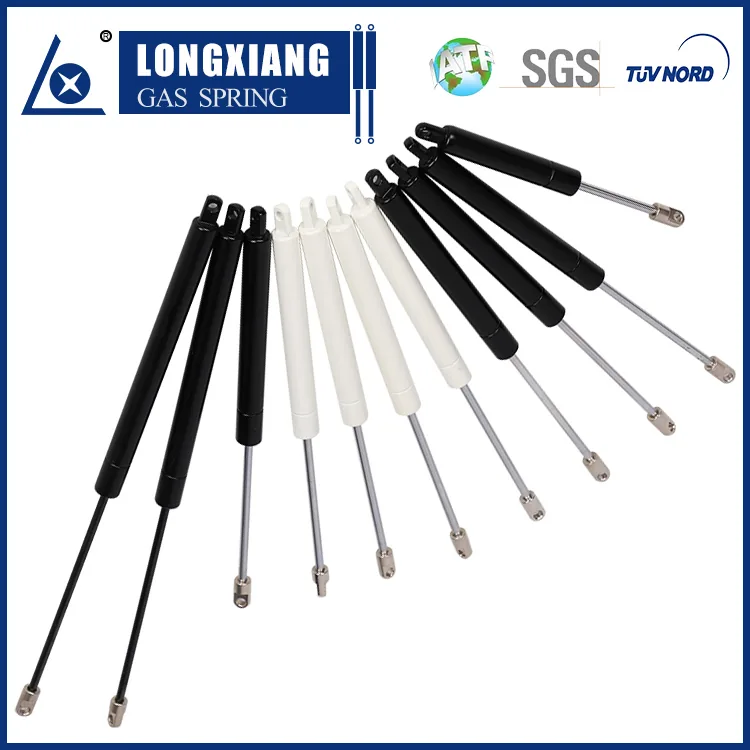
When a lid, hatch or chair no longer stays open, the gas spring has usually lost pressure. Replacing it is simple once you know exactly what to order. This guide shows how to identify a gas spring from the part itself, even when the label is worn off.
Short answer: note the force and code printed on the tube, then measure the extended length centre to centre of the end fittings, the stroke, the rod and tube diameter, and the type of end fittings. With those five things a matching gas spring can be made; a photo of the part and its brackets makes the match certain.
Before You Start: Safety
- Support the lid, hatch or panel with a prop before removing anything. A worn gas spring may no longer hold it.
- Replace one gas spring at a time on two-spring designs, and replace both springs together so they push equally.
- Never drill, cut, heat or try to open an old gas spring. See the safety guide.
Step 1: Read the Label
Most gas springs have printing on the tube. Look for:
- Force in newtons, for example 100N, 250N or 500N. This is the most important number.
- A part number or code. Formats differ between manufacturers, so a code alone may not identify the size; send it together with the measurements below.
- A date or batch code, which helps if you are replacing an original equipment part.
If the label is worn away, the force can be estimated from the lid weight with the gas spring force calculator.
Step 2: Measure the Gas Spring
Measure with the rod fully extended, in millimetres:
| Measurement | How to measure |
|---|---|
| Extended length | Centre of one end fitting to the centre of the other, rod fully out |
| Compressed length | Same, with the rod fully pushed in (or extended length minus stroke) |
| Stroke | Length of the visible piston rod, from the seal to the end fitting |
| Rod diameter | Measure the rod with a calliper, for example 6, 8, 10 or 14 mm |
| Tube diameter | Measure the tube with a calliper, for example 15, 18, 22 or 28 mm |
| End fittings | Ball socket, eyelet, clevis fork, blade end or threaded stud; note ball stud size or thread |
Always give lengths centre to centre of the fittings, not end to end of the metal parts. See the dimensions guide and the end fittings guide.
Step 3: Check the Mounting
- Note which way the spring is fitted (rod up or rod down) and photograph both brackets.
- Check the brackets and ball studs for bending, cracks or wear; a damaged bracket can be what destroyed the old spring.
- If the lid used to rise too fast or not stay open, tell us; the force can be adjusted on the replacement.
Step 4: Order and Replace
Send the label details, measurements, end fittings, quantity and photos through the quote form. When the new springs arrive, fit them the same way round as the originals, check that the lid opens smoothly and stays open, and keep hands clear of the hinge while testing.
Why Gas Springs Need Replacing
Gas springs slowly lose pressure as the seal wears. Side load, damaged rods, heat, corrosion and very frequent cycling shorten their life. Read how long gas springs last and the maintenance guide.
Frequently Asked Questions
Can I use a stronger gas spring than the original?
Only slightly. A much stronger spring can make the lid fly open, overload the brackets and make it hard to close. If the original was too weak, choose a modestly higher force and test it.
Can a gas spring be refilled or repaired?
No. Production gas springs are sealed and should be replaced, not refilled or opened.
Should I replace both gas springs at the same time?
Yes. Two springs of different age push unequally, which twists the lid and wears the new spring faster.
What if there is no label on the gas spring?
Measure the extended length, stroke, rod and tube diameter and end fittings, and estimate the force from the lid weight with the force calculator. Photos of the part and brackets help confirm the match.
How do I measure the length of a gas spring?
Measure from the centre of one end fitting to the centre of the other with the rod fully extended. The stroke is the length of the exposed rod.